Mara Richter · 26 September 2026
The Intersection of Security Protocols and Platform Evolution in SaaS Environments
Software as a Service platforms have expanded rapidly since the early 2010s and now support millions of users across industries through shared infrastructure and continuous updates. Platform architectures shifted from monolithic designs to microservices and containerized deployments while security protocols adapted in parallel to address new vulnerabilities that arise during these transitions. Researchers at institutions such as the Massachusetts Institute of Technology documented how multi-tenant environments require stricter isolation mechanisms compared with earlier single-tenant models.
Platform Evolution Patterns in SaaS
Early SaaS systems relied on centralized databases and basic authentication yet operators soon encountered scalability limits as user bases grew. Companies responded by adopting distributed systems and API-first approaches that allow independent scaling of individual components. Data from the European Union Agency for Cybersecurity shows that organizations implementing modular architectures reduced downtime incidents by measurable percentages between 2018 and 2023. These changes introduced new entry points for threats and prompted revisions to access management standards that had previously sufficed for simpler setups.
Security Protocol Adaptations
Protocols such as OAuth 2.0 and OpenID Connect replaced older password-only systems in most production environments because they support delegated authorization across multiple services. Transport Layer Security versions evolved to 1.3 and higher while organizations phased out legacy cipher suites that no longer meet current benchmarks. The Canadian Centre for Cyber Security published guidelines in 2024 that recommend regular rotation of cryptographic keys in SaaS deployments to mitigate risks associated with long-lived credentials. Implementation teams now integrate these protocols directly into continuous integration pipelines so updates deploy alongside feature releases rather than as separate patches.
Integration Points Between Security and Evolution
Zero-trust models gained traction as platforms moved workloads across hybrid clouds because perimeter-based defenses proved insufficient once internal traffic increased. Engineers embed identity verification at every service boundary and log all requests through centralized monitoring systems that flag anomalies in real time. A study conducted by academic researchers at the University of Melbourne examined over 200 SaaS providers and found that those enforcing least-privilege access across microservices experienced fewer lateral movement incidents during simulated attacks. Platform updates therefore incorporate automated policy checks that validate compliance before new code reaches production stages.
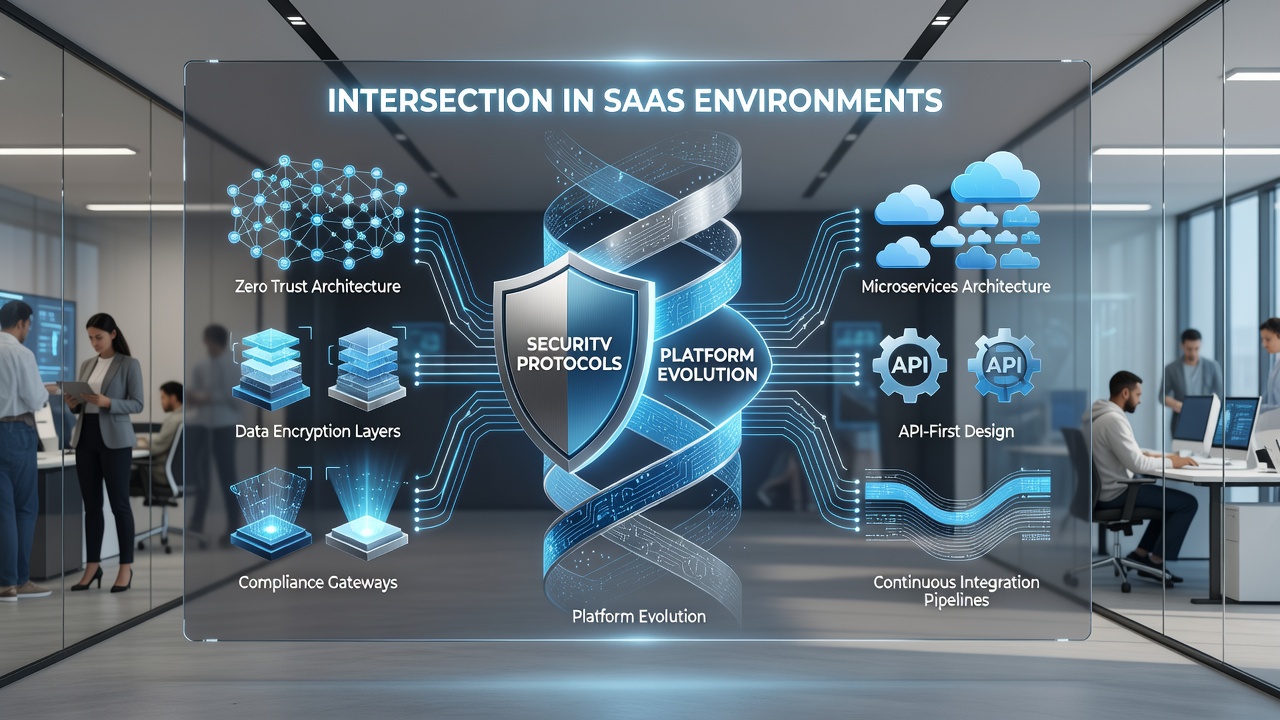
API gateways serve as another convergence point where rate limiting, input validation, and token introspection occur simultaneously. As platforms introduce serverless functions or edge computing nodes, these gateways extend protection to previously decentralized resources. Observers note that September 2026 marks the scheduled rollout of enhanced reporting requirements under several international frameworks which will require SaaS operators to demonstrate continuous protocol compliance through automated audit trails.
Compliance and Regulatory Influences
Regulations such as the General Data Protection Regulation in the European Union and the Personal Information Protection and Electronic Documents Act in Canada shape how platforms handle data residency and encryption at rest. Teams align security roadmaps with these rules by mapping protocol choices to specific articles and clauses rather than treating compliance as an afterthought. Industry reports indicate that providers who embed regulatory checks into their evolution cycles achieve faster certification renewals and avoid service interruptions during audits.
Technical Implementation Examples
One documented case involved a financial analytics SaaS provider that transitioned its core database layer to a sharded architecture while simultaneously upgrading authentication to support hardware security modules. The project required coordinated changes to both the data partitioning logic and the key management service so that encryption remained consistent across shards. Another example comes from a healthcare records platform that adopted mutual TLS for all internal service communications after expanding its footprint to additional geographic regions. These adjustments illustrate how security considerations directly influence the sequence and scope of platform modifications.
Conclusion
Security protocols and SaaS platform evolution remain tightly coupled because each architectural shift alters the threat surface that protocols must address. Organizations that treat these elements as integrated rather than sequential components maintain operational continuity while meeting evolving regulatory expectations. Continued monitoring of protocol standards alongside platform metrics provides the data needed for informed decisions about future updates.